by Barbara Nichols
As technology changes we have to grow and change too. Here at the editor's desk of TATP, I am always trying to upgrade and make things work better for you the reader. Blogger (who owns the domain on which this newsletter is published) recently has made improvements to the format of how we view our newsletter. That's the reason that I was able to change the "look" of Christmas newsletter and now am able to change the "look" of this spring newsletter. However, with change comes problems sometimes, and in this case we have discovered that sometimes some computers are having problems with printing a copy of the newsletter. We have decided that in the interests of simplicity for our readers, and in the interest of making our newsletter accessible to all, that we would continue to publish the newsletter in blog format (online) while also sending you a document via email that you can open and print with ease. The email that we sent to you should have had an attachment that you could open and print but you can still read our newsletter online too. I hope you will find that I am always trying to improve and make this publication as current and as accessible as possible.
You will find in the pages of this issue a funny story of some knitting that went missing, and an article on Swedish Weave. You will also find the regular articles, those being the general reports of our member groups and Pot Pourri with some pointers for using thrums in your projects. Also, I have included a new page at the top, directly under our title and header, for those who want to print a copy of the application for scholarship. You will be able to access it at any time. I am also beginning a list for weaving supplies, and another list for spinning supplies. These lists are to help you find your online spinning, weaving and felting needs. If you have a website that you would like to add to our list let me know at our email address PeaceCountrySW@gmail.com and I will be glad to include it.
I look forward to seeing you all at the spring conference in Fairview/St. Isadore.... and if I don't get to see you all then... well I'll be sorry for that and hope to see you all in the fall. Take care till next time.
The President's Message
by Renate Giesbrecht
March 2011
It seems a little late to be saying it, but never-the-less here goes, "Happy New Year". I continue to marvel at how quickly a year goes by. I'm convinced that the world is spinning faster and faster and time is going more quickly. We have an exciting year lined up with the spring conference in Fairview and the fall conference in Hudson's Hope. Please write the dates on your calendars so you will be there. They are both looking to be 'not-to-be-missed' events. Remember to bring lots of show and tell items to Fairview as the St. Isadore ladies requested. They will share with us what they weave but would like to see our work too. Sounds fair to me.
I thought I would let you know how my fibre garden turned out. The flax was a success and Gerry (my husband/assistant) and I pulled it up and dried it in early fall. It is now waiting for warm weather so I can rett it and continue with the process. Gerry has built a brake and scutching knife and is working on a hackle. The cotton was a bit of a bust. The plants grew well, up to 5 and 6 feet tall. They bloomed and I did get a couple of bolls but the plants were constantly plagued by aphids. It was the first time I have had a problem with aphids in the green house. The plants really suffered for them and eventually it was a losing battle. Yes, the aphids won that round. But I will try again this year and be on the look out for the pests. That was part of the problem - the plants were very infected by the time I realized what was happening. I am looking for advice on how to avoid or deal with this problem. If you have any experience with this, please let me know.
I am looking forward to seeing all of you in Fairview. Keep on spinning and weaving.... Rene
Reports
Fairview
by Doreen V.
The weaving studio at the Fairview Arts Centre has been humming just about every Monday since Christmas. We got our rugs off the rug loom and Verla is busy dressing it again for the latest rug that was in the Handweavers Nov/Dec 2010 edition. It's a weft faced rug in a very interesting pattern. Verla has finished her bag, so that loom is waiting another weaver. Loretta is finishing her rep-warp placemats and Maisie and Doreen are working on their Theo Moorman pieces so that we can have the looms free for the spring conference. Doreen's material on the corner loom is weaving up well. It was a real experiment and looks quite promising. We are also hoping to start a project to use up everyone's thrums and then we'll use what we create to weave a rug.
We are getting the Inkle looms fixed up for a weaving project with young students, hoping to get a small group doing weaving using different kinds of techniques: e.g. finger weaving, Rigid Heddle, Inkle loom and maybe even card weaving and the backstrap technique of the early North and South American weavers that continues today. The Ag Society has funded some projects for our group so the plans are being made. One of these projects involves teaching knitting to grades three to six students at EEO elementary school. Loretta and Doreen go there on Mondays, Tuesdays and Wednesdays to teach knitting. We have a group of twelve students, some knitting with needles and others finger knitting. It's a great way to get the kids interested in some of the old ways of doing things.
In other news Ellen fell about a week ago and broke her ankle fairly badly. She will be off her feet for six weeks. She's had surgery and they've inserted two screws and a plate to hold the bone in place. I talked to her and she's comfortable, waiting for a second cast. We all wish her a speedy recovery and then she'll be back weaving and quilting at the Centre.
We are looking forward to hosting the group at the Spring Conference. See you all then and keep weaving.
Fort St. John (NPSW)
by Laura lee L.
The Guild has been keeping busy this winter. In December we held our annual Christmas


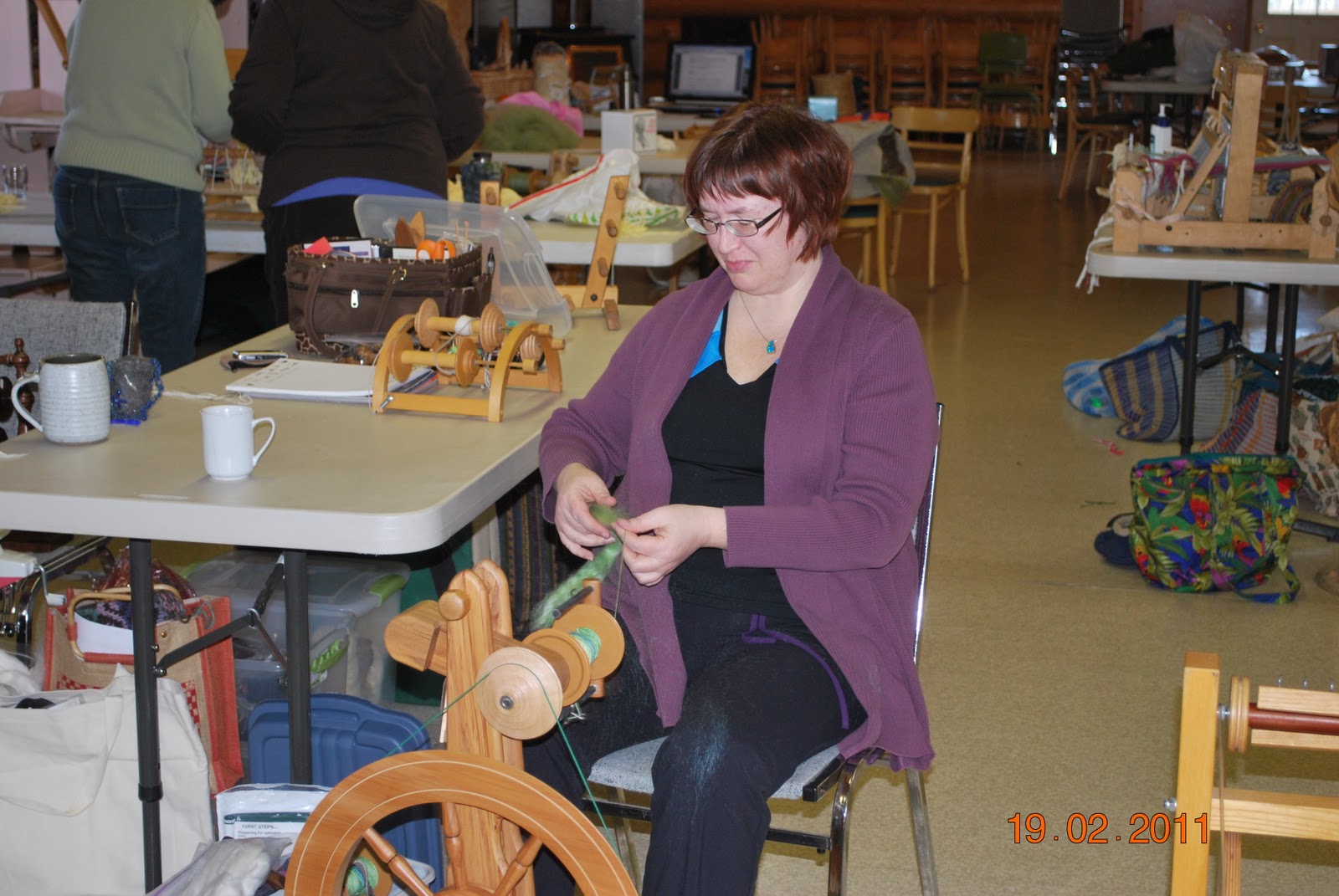
February, of course, was the "Blueberry Retreat" month. This year, we rented the facility from Wednesday, Feb.16 to Sunday, Feb. 20th attendance varying according to individual schedules. As usual, there was lots of visiting, lots of progress on projects and an overall good time was had by all.
 |
| L. H. cards wool on drum carder. |
 |
| R.G Spin yarn on her wheel. |
 |
| N.C. weaving on Inkle Loom. |
 |
| F. E. and M. W. spin and visit. |
 |
| M.B. has a nice big smile before she gets started for the day. |
 |
| M. F. is spinning a mohair yarn. |
 |
| K. K. practicing spinning. |
 |
| F.E. has obviously got good dye results. |
Frankie Nichols gave a percentage dyeing workshop on Saturday - very interesting even for those who did not directly participate. Two members of our beginners' weaving class joined us on Saturday to get extra assistance on their projects. Having visitors adds so much to the fun. A brief meeting Saturday evening decided that, in future, anyone registering for a multi-day Guild event will be asked for a non-refundable deposit as part of their fee. When there are significant expenses - such as rentals, insurance, instructors' fees, etc. - that have to be paid regardless of attendance, last minute cancellations put unexpected and unfair burden on the other participants.
The "Fibre Academy" is progressing gratifyingly well. The Beginners Weaving Class has finished dressing one of the 36" looms - and their own personal looms - and are embarked on weaving samples on the warp, on which they worked so hard. The next beginners class held was a drop spindle/spindling course on March 5, 12, and 19th taught by Frankie N. and Rene G. So far that class has been a success as students learn to spindle through class room instruction and completing homework of spinning different preparations of fibre to ease their learning from beginner to beyond.
 |
| M.J. is working on her carding skills. |
 |
| M.A. is working on rolags. |
 |
| D.S. is working on flick carding. |
 |
| N.C. is learning to draft on the drop spindle. |
The Intermediate Weaving Workshop group has decided to study "waffle weave for their first topic. Members will research and dress their portable looms independently, then come together workshop their findings and weave samples in "round robin"session.
The Studio looms are all busy. Norma Currie and Faye Eggleston have been weaving blankets - wool and cotton - on the 60" loom. They are now dressing it for a shawl project in acrylic novelty yarns. The other 36 " loom was warped for "Forest" acrylic, double weave tote bags, and is currently booked until April. Cheryl P. has warped the 45" loom for crackle weave - a runner or placemats - and members started weaving in early February. They are being challenged - Cheryl has provided instructions for quite a range of weaving and colour variations!
Studio Wednesdays have worked well for some members, but attendance has been erratic, so we will be reviewing this program. It's great having the studio available, but a different scheduling system may work better. The Arts Council and Arts Post II are still in a tight spot - busy planning how to increase local awareness and raise money to defray costs. A casino night at Chances, in April, is one of the most recent projects. The Guild's lease runs until the end of May, when we find out if we can continue to maintain the studio. We also are sifting through ideas for fund raising, hand-made sachet bags and Christmas ornaments being two ideas we are considering.
In the meantime, we have our North Peace Art Gallery show, provisionally titled "Shawls, Scarfs, Socks, and Shoelaces", looming (pun intended) on the horizon for next October. the March meeting has been changed to "UFO and troubleshooting", and April will be occupied by the P.C.S.W. conference. However, in May we will be making our annual trek to Hudson's Hope to impose on Frankie's hospitality and making shoelaces by Tablet, Inkle, and Kumihimo... all weaving which will be explored. Maybe by then the snow and cold will finally end!
Hudson's Hope
by Barbara Nichols
Pat M. has been busy working on the fall conference and you will see the information regarding that further along in the newsletter. Meanwhile our group, having been decimated in numbers over the last year, struggles to keep it's head above water. Carol continues to meet with Frankie every now and again to spin, but sometimes we feel that we just don't have enough time to work together. Carol is spinning a very fine wool fibre that she is hoping to make into a six ply yarn for socks. Her socks are so sturdy that I think they could stand on their own! Meanwhile Frankie continues on with her work for her Master Spinning courses. She has recently been scratching her head over her efforts on the flax front and she feels that she has absolutely no talent in that area.
 |
| Flax samples. |
She is working on a knitted counterpane from a pattern in the Jan/Feb edition of Piecework magazine with yarn that she dyed using a percentage technique.
 |
| Percentage dyed skeins. |
 |
| Knitted square for traditional counterpane. |
 |
| Cotton singles. |
 |
| Plied cotton in skeins. |
She has also been working on Swedish Weaving techniques in order to be able to write an article for this newsletter. (She is always wishing that someone in our guilds will write a weaving article!!! HINT HINT) She also has been hoping to get a warp on her new Inkle loom but with everything else going on in her life she just doesn't seem to get to it. Perhaps a group Inkle loom workshop would be good. We, here in Hudson's Hope, continue to hope that we will find some others in our community who share our interests in spinning and weaving. But in the meantime we continue to shepherd our sheep, watch lambs being born, and think of all things fibre.... we wish you all a great spring full of spinning, weaving and dyeing.
Saskatoon Lake
by Mae T.
Looking out on the snow drifts in our yard, it is hard to imagine Spring is around the corner. Everyone is busy, Shannon has her mohair afghan on the loom and is about to start weaving.

The colours are beautiful, with dark grey and burnt orange. Marion is weaving tea towels in soft pastel shades with a delicate pattern.

Mae is threading the wool silk shawl of many colours. Adding extra heddles is taking time 120 per heddle. Gudrun is weaving hand towels, which are very attractive.

Verna May is winding warp for a scarf. Joan is planning her next project and helping Nancy plan hers. The group is weaving hand towels.

Happy weaving to all...
Valleyview
by Josie M.
Hi Everyone. We have had four fibre club meetings in Valley view since the last newsletter. The December meeting was held at Jody McLean's house where we were given the opportunity to play with dye and dyeing techniques. We practiced mixing colours and learned how to calculate the amount of dye needed for our projects. We also had a Christmas gift exchange. This was great fun. We had drawn names earlier in the year and each had to make something for that person using fibre. No rules, we just had to make it ourselves out of some kind of fibre no matter what our skill level or expertise. There were amazing gifts including felted purses and scarves, hand felted ornaments and wall hangings,
 |
| Angora bunny wall hanging. |
hand spun wool and hand spun, naturally dyed knitted socks. The gift exchange was a great idea and I think we will consider it again for next year.
The next three meetings were at Josie's house. January's meeting theme was knitting and crocheting. Members worked on ongoing projects or learned new things from other members. In February, most of us tried Nuno felting and those of us that had tried it in the past showed off the previous projects and helped everyone else get started. There were some very beautiful finished projects.
For our March meeting we didn't have a theme so everyone just worked on their own projects or visited. As Jody has already started lambing we had a little visitor at this last meeting.


He was certainly the life of the party. Anything to remind us that spring is coming soon is a good thing. Happy spring everyone.
Conference Information
Peace Country Spinners & Weavers - 2011 Spring Conference
April 29 & 30, 2011 – Fairview/St Isadore
Hello Everyone! We hear tell of Pussy Willows starting to show, a definite sign of Spring!!
Fairview Guild is excited to host the 2011 Spring Conference and introduce our main presenter, Pirkko Karvonen.
Pirkko Karvonen was born in Finland 1935, moved to Alberta in 1951 as a teenager and later returned to Finland in the 1970's to study textile design. She has been instructing various weaving techniques, that include, but are not limited to, paper yarn weaving, False Damask, Finnish ethnic traditional techniques and card weaving since 1969. She was part of the team instrumental in the founding of the Hand Weaver, Spinners & Dyers of Alberta in 1974, as well the Strathcona County Weavers. Pirkko has made significant contributions to the textile community in Alberta, as well as across Canada.
Pirkko, along with her husband Albert are considered as two of Alberta's most prolific and accomplished documentary filmmakers, having produced over 100 nationally and internationally acclaimed nature documentaries.
Friday evening at 6:30, for those who can make it, we will start with a social evening. You will have a chance to renew acquaintances or maybe make some new ones. During the evening, Pirkko will be demonstrating a 10 minute Card Weaving warp, and those who would like to try are welcome. This is a perfect opportunity to engage in an ancient art form that has been around since Egyptian times! Please remember to refer to the itinerary for a list of supplies. If you prefer just to observe, feel free to bring other spinning, knitting or other fibre crafts you are working on.
Saturday, we will start at 8 am with Registration and a continental breakfast.
For the morning, Pirkko will be demonstrating drafting and sampling, on both 4 & 8 shaft, Summer & Winter Weave, as well as 4 & 8 shaft False Damask. There will be some pattern theory and design, followed by how that translates to the actual weaving on a loom.
We will break for lunch and the PCSW spring meeting around 11 am.
The later part of the conference will entail a road trip to St Isadore, where the very talented French Canadian ladies of the St Isadore Guild will give us a tour of their very prolific studio, followed by a demonstration of how they sectional warp their production looms in the traditional way. If we are lucky, we may see them “dance with their looms!”
We will then have some time for Show and Tell between the PCSW conference members and the
St. Isadore ladies. Please remember to bring whatever you are working on, items you have been inspired by, or some projects completed that you would be willing to show and share your thoughts of inspiration and any technique or process that intrigued you. Pirrko will be bringing some of her Finnish rug samples she is wanting to share with the group, as well as some other samples.
St. Isadore ladies. Please remember to bring whatever you are working on, items you have been inspired by, or some projects completed that you would be willing to show and share your thoughts of inspiration and any technique or process that intrigued you. Pirrko will be bringing some of her Finnish rug samples she is wanting to share with the group, as well as some other samples.
That will conclude our time together!
At this time I would like to acknowledge the Fairview Ag Cultural Society by thanking them for their
very helpful donation to this endeavor.
If accommodations are needed, the Dunvegan Motor Inn, located on Hwy 2 on the South end of Fairview, would be the nicest. (780)835-5100, www.dunveganinn.com or reservation line 1-800-546-8898. There is a restaurant and a lounge in the facility as well.
Any questions? Or to Register… Contact Loretta Skaley (780)765-2175 or wlskaley@hotmail.com
2011 PCSW Spring Itinerary
Fairview/St. Isadore April 29, and 30, 2011
Friday 29th:
6:30 - 7pm: Registration for Card Weaving with Pirkko Karvonen or just come and socialize. Bring your spinning, knitting, or whatever you are working on. Hosted by the Fairview Guild as the Fairview Fine Arts Centre, 10801 - 103 St. in Fairview, AB (Just east of the hockey arena for you hockey/figure skating people.
7 - 9 pm: Card Weaving Demo with Pirkko Karvonen (and try it out if you like) - PCSW member - (included with conference fee), non-PCSW - $20.00.
$3.00 workbook fee/participant.
Bring your own Card weaving cards or make your own (Instructions to MYO weaving cards included below) 4/8 warp cotton (available to purchase from instructor ($3) or bring your own. (20 to 25 people are able to participate & open to public)
Register by April 15th. contact Loretta S. via email PeaceCountrySW@gmail.com.
----------------------------------------------------------------------------------------------------------------------------
Saturday 30th:
8:00 to 8:30 am: Registration and Continental Breakfast
Saturday 30th:
8:30 - 11:00 am: Pirkko Karvonen presents:
Drafting and sampling on 4 & 8 shaft - Summer and Winter,
Drafting and sampling on 4 & 8 shaft - False Damask
(PCSW member - $50.00, non-PSCW member - $100.00) $3 workbook
fee/participant. (20 -24 people able to register)
Register by April 15th contact Loretta Scaley PeaceCountrySW@gmail.com
11:00am - Noon: Lunch and PCSW meeting
Noon - 1:15 pm: Car Pool to St. Isadore
1:30 - 4:30 pm: St. Isadore - Studio tour and Sectional Warp Demo, then tea and Pirrko's Finnish Rugs/ PCSW Show and Tell
PCSW members - included with conference fee, Non PCSW member $20.00
(20 - 25 people able to participate & open to public)
4:30 - 5 pm: Time to pack up, say Good-bye and head home... till Hudson's Hope this fall!
Materials For Students To Bring
1. Two C 4: clamps
2. A board about 3" x 26"thick scraps from lumber yard.
3. 24 cards (tablets) made of milk cartons (or see previous links for instructions on how to make tablet cards)
4. pencil and coloured pencils
5. panty hose we will use it for tying the tablet weaving.
6. contrasting colours (2, 3, or 4) can be mercerized crochet cotton that you have available at home. Instructor will also bring 10/2 cotton for purchase
7. Felt pen - large line
8. Scissors
9. Warping boards, 4 containers to put yarn in when making warp. Instructor will bring one warping board.
10. Instructor will bring samples.
-------------------------------------------------------------------------------------------------------------------------------
Pot Pourri
by Joan Y.
Well hallelujah! It's March and despite the groundhog's predictions, I think spring is only a month away. We can handle that, eh? Of course, we have been shut in quite a bit in 2011, but we have all these indoor fibre crafts to keep us from total collapse due to "cabin fever".
To be honest, I did have a two week collapse at the end of January nursing a mild case of shingles, luckily discovered and medicated early.
Now to go back to the main course, fibre arts and crafts. Though our Saskatoon Lake group has missed several get-togethers due to weather and road conditions, the looms and wheels and needles at home have kept on working.
Personally, I have taken time to put my many year's stash of thrums to work. I made some runners with 9 inch thrums, but my best use of thrums has been to chop them into 1 inch pieces and use them as stuffing for two small cushions.
There are other suggestions in several weaving magazines regarding using up thrums such as for mug rugs and hot pot holders. Then, of course, there is the tedious but delightful project of a Rya rug. Or you can make rugs by incorporating thrums at intervals in regular weaving to make intermittent tufts. Or again, you can tie longer thrums together, then ply several strands together and let the knots pop up where they will. some of these ideas could be used also on tote bags, purses, or vests, etc.
Use all your creative skills to keep from wasting all those expensive threads just because they are short, and have a satisfying week or two.
-------------------------------------------------------------------------------------------------------------------------------
-------------------------------------------------------------------------------------------------------------------------------
Fall Conference 2011
September 23, 24, and 25th, Hudson's Hope
Friday 6pm: Will be a "Meet and Greet" starting at 6 pm with a presentation by Sandra Fearon
on the Guild of Canadian Weavers Testing program that leads to a Master Weaver
designation. A glass of wine and appetizers will be available for a small donation.
Saturday 8:30 - 9:30 am: Sign -in.
9:30 - 5 pm: Workshop..... supper break (cost not included in registration).... followed by
more workshop.
Sunday 8:30 am: Continental Breakfast
9:30 am: Finish workshop
Workshop #1
Shadow Weave with Sandra Fearon/cost $160.00 (includes workshop binder, Saturday and Sunday breakfast and lunch).
Max participants: 16
A two day workshop to discover the elements of Shadow Weave design from the subtle to the psychedelic, exploring ways to alter the colour placement, tie-up and treadling, to create unique designs.
Some degree of weaving experience is needed (advanced beginner at least). Weavers will prepare their own looms (4 or 8 shaft) prior to class and will need to be familiar with multi-coloured warp preparation and using multiple shuttles.
Warping instructions will be provided at least a month before the workshop. the warp will be 8/2 cotton or the equivalent.
Workshop #2
Art Journaling for the Fibre-Inclined with Barbara Daley/cost $125 (includes basic materials and 'Stash Starter' Saturday and Sunday breakfast and lunch).
Max. participants: 14
Barbara will direct you in creating a canvas scroll that appeals to the "fibre- inclined"., be very portable and lend itself to "spontaneous bouts of journaling!" You will create this journal for your inspirations, musings, and because of your unique love affair with fibre and fabric. Barbara describes her workshop as a "boutique experience" at which she speaks to each participant beforehand. She will supply you with a starter, "Stash Injection" for your journal. you will need to bring fabrics, fibres, small weavings, articles and inspirations.
Important Note: Due to the potential popularity of this workshop we would like to give members who do not live in Fort St. John (or close) first chance at this. For those who do live in Fort St. John (or close) a workshop with Barbara will be planned in the near future.
Let's have an exchange table.
Bring what you can't use, take what you can....
PCSW Fall Registration Form
Please mark which workshop you are registering for. #1. Shadow Weave__________
#2. Art Journaling___________
Mail to: The Pearkes Centre, Box 267, Hudson's Hope, B.C. V0C 1V0
Name: ____________________________________________________________________
Address:__________________________________________________________________
Phone/Cell/Email:___________________________________________________________
A minimum $75 non-refundable fee is required. Cheque payable to:
Peace Country Spinners and Weavers
Registration Deadline May 1st, 2011
------------------------------------------------------------------------------------------------------------------------------
A Squirrel Story
by Debbie S.
For Christmas this year I decided to knit a lacy cardigan for my mother-in-law. She chose a lovely soft pink merino-alpaca blend for the fibre. Because of the complicated pattern I began knitting in early September which was when my husband, John, and I went off for two weeks of camping holidays. We were at Hereld Prov. Park, north of Salmon Arm when due to rain we decided to stay put, and relax for a day or so… a wonderful opportunity to get some uninterrupted knitting done.
During a break in the rain we took an hour to wander the campsites and lake side, but when we came back to the camper, the picnic table was empty. The only thing left was a thin pink yarn strand heading off into the trees. It took about 15 seconds to realize that the cute, furry squirrels that we had been aware of, had transformed into nasty thieving rodents.
I began running around the site and nearby bush while my husband started asking neighbouring campers if they’d seen a pink ball of yarn run by. (Which got some very interesting reactions.)
After looking frantically for my missing knitting, I suddenly I spied my knitting 10 feet up out on a tree branch, needle and all still in place!
John and a nearby camper came running over, laughing so hard they could hardly stand.
During a break in the rain we took an hour to wander the campsites and lake side, but when we came back to the camper, the picnic table was empty. The only thing left was a thin pink yarn strand heading off into the trees. It took about 15 seconds to realize that the cute, furry squirrels that we had been aware of, had transformed into nasty thieving rodents.
I began running around the site and nearby bush while my husband started asking neighbouring campers if they’d seen a pink ball of yarn run by. (Which got some very interesting reactions.)
After looking frantically for my missing knitting, I suddenly I spied my knitting 10 feet up out on a tree branch, needle and all still in place!
John and a nearby camper came running over, laughing so hard they could hardly stand.

As I grabbed a tent pole to snag it down the squirrel came back to retrieve its treasure. I was wacking the branch, beating back the rodent (really frowned upon in Prov. Campsites) and John ran for the camera, yelling,”Wait a sec. No one will believe you without a picture.”
When I managed to bring down the knitting and sat down to check the damage, I found that after all, only about 4 rows had been chewed and about two hours later, (which really wasn’t too bad), I was ready to continue.
When I managed to bring down the knitting and sat down to check the damage, I found that after all, only about 4 rows had been chewed and about two hours later, (which really wasn’t too bad), I was ready to continue.

I knew how many hours of work the squirrel could have destroyed so as a peace offering I rolled little balls from the remnants of the ruined rows , put them at the base of a nearby spruce and wandered off. When I returned ten minutes later, the balls of wool I had left as an offering had disappeared.
Somewhere this winter, some little squirrel is sleeping curled up in a soft pink alpaca nest. And considering how soft the alpaca fibre is, I can’t say as though I blame her. : )
Turning Tabby Into Awesome
by Frankie N.
Turning Tabby Into Awesome
by Frankie N.
I have bought several tri-looms over the last two years and though I don't get a lot of time to work with them I have occasionally looked at them standing in the corner and thought well I'll have more time for them later on. Recently a friend told me about a tri-loom group on Yahoo that she thought I should join, so for information purposes I decided to have a look. I joined straight away as it seemed to be a fairly active group and I thought I might learn a little something. I wasn't wrong.
Shortly after I joined the group someone emailed into the group with a picture of a child's poncho that she had finished and had embellished with Swedish Weave. I had a look and discovered that Swedish Weave is beautiful. I do realize that some of you will probably know all about Swedish Weave as some of you are far more knowledgeable than I, but for me it was a new opportunity to understand a new technique of needlework.
Swedish Weave is also known as Huck embroidery. It is deceptive in that it is not a weaving technique at all but an embroidery technique. It took a bit of research to learn this but once I did I was gung ho to learn. Even though it is not a weaving technique it can make your weaving, in particular, your Tabby weaving look more interesting. I have included a few pictures as examples of Swedish Weave...


I then went looking for patterns that I could download and use while waiting for a few books from Amazon on the subject. I found these.


 |
| Thanks to Karen's Variety for this pattern. |

Armed with everything I had seen I was ready to produce my first sampler. I had purchase a six inch pin loom from Hazel Rose Looms some time ago and so I began my project with it.
I used Gems yarn from Louet and began by warping my loom.

Once I had finished warping, I wove the whole piece plainly. Most Swedish Weave is done on Monks cloth but I felt that I could manage on any tabby weave cloth and I felt that this loom would yield a fine enough cloth to give me a lovely sample.

I then took two small skeins of the Gems and threw them into the dye pot one with a larger amount of dye giving me a dark green. The other skein went in the pot after most of the dye had been exhausted giving me a lighter shade of the same green.
I then began my sample. Working from the inside of the pattern I began stitching under the warp threads as the pattern called.

Slowly I worked my way through the pattern.


Taking the piece off the loom and easing the tension changed the appearance of the piece altogether. Suddenly the negative and positive space switched. I have completed one block and am very pleased with the results. Now I just have to do seven more in order to finish the piece for a table runner. It will be a gift for one of my fellow knitters who will be moving away from our community later this spring.
Swedish Weave can be completed in any weight of yarn. The original poncho that I had seen and at first caught my interest was done in a bulky weight acrylic yarn. For those of us who are content with Tabby weave, Swedish Weave seems to be a technique that can embellish and beautify our work.
All I know is that I'm hooked!
And I hope you will be too.


